June 27, 2026
Danilo Grande
A Framework for Collective Spatial Behavior

A Framework for Collective Spatial Behavior
There is a distinction worth drawing between a system that reacts and one that behaves.
Reactive systems are everywhere. A motion sensor activates a light. A thermostat reads temperature and adjusts. Input produces output. The relationship is linear, predictable, and — above all — closed. Nothing changes except the output.
Behavioral systems are something else. They do not simply respond to the world. They form a relationship with it. They absorb, interpret, evolve. Their output shapes the conditions that generate their next input. They exist in a continuous loop with the environment they inhabit.
This distinction is not philosophical decoration. It is the architectural difference between a tool and an organism.
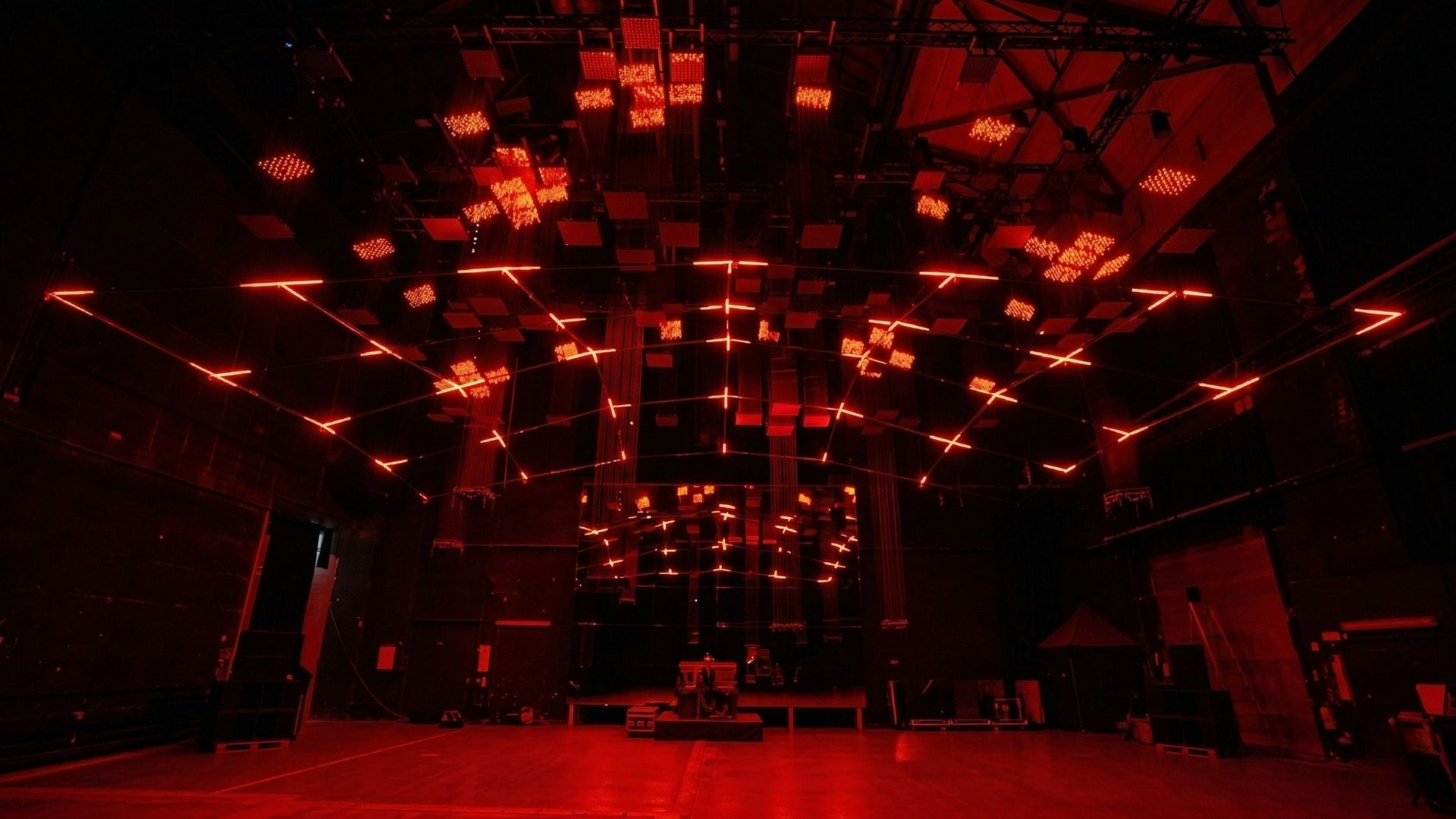
At LedPulse, this question has governed how the Dragon was built from the beginning. Not as a technology designed to display, but as a spatial organism designed to behave. What follows is a working account of what behavioral organisms actually are, how the Dragon embodies that category, and why this approach redefines what spatial experience can be.
.jpg)
The defining characteristic of a behavioral organism is the closed loop: perception feeds cognition, cognition drives behavior, and behavior re-enters the system as new perceptual data. There is no beginning and no end. The system is recursive.
In biological organisms, this architecture is simply called life. The nervous system gathers sensory input, the brain interprets it, the body acts, and the consequences of that action return as new sensation. The organism is never in a static relationship with its environment. It is continuously negotiating one.
The Dragon operates on the same structural principle. Through a distributed network of sensors, it detects human presence, movement, proximity, and attention. These signals are not fed directly to an output layer. They pass first through a cognitive layer — LYRA — where they are interpreted as meaning. Only then does the Dragon express: through volumetric light, kinetic movement, and spatial transformation.
Perception. Cognition. Expression. A loop with no exit.
This is not reactive lighting. Behavior emerges from the continuous cycle.
Most interactive systems skip the middle step. Input maps directly to output. Press a button, hear a sound. Break a beam, trigger a sequence. The relationship remains binary.
What makes behavioral organisms distinct is the introduction of an intermediate layer: state. State is the accumulated internal condition of the system — the sum of everything it has perceived, interpreted, and retained. It is not a single data point. It is a live model of the environment.
In the Dragon's architecture, state is computed from two primary variables: attention and coherence.
Attention is not directly measured. It is inferred — from the density of presence, the quality of stillness, the degree to which people are directing their focus toward the space. Attention represents intentional presence. When it accumulates, the system responds with elevation, clarity, and structural precision.
Coherence is something else. It describes the degree of synchrony between individuals in the space. Isolated movement generates local reactions. But when people align — through synchronized stillness, coordinated attention, shared behavior — coherence increases and the system enters a different order of response. The transformation is no longer localized. It is spatial. The entire field reorganizes.
This is why individual interaction and collective interaction produce qualitatively different experiences. The system is not scaled up. It is shifted to a higher behavioral state.
For a behavioral organism to function in three-dimensional space, its cognitive layer must understand that space in precise geometric terms. Interpretation cannot remain abstract. It must be translatable into exact spatial action.
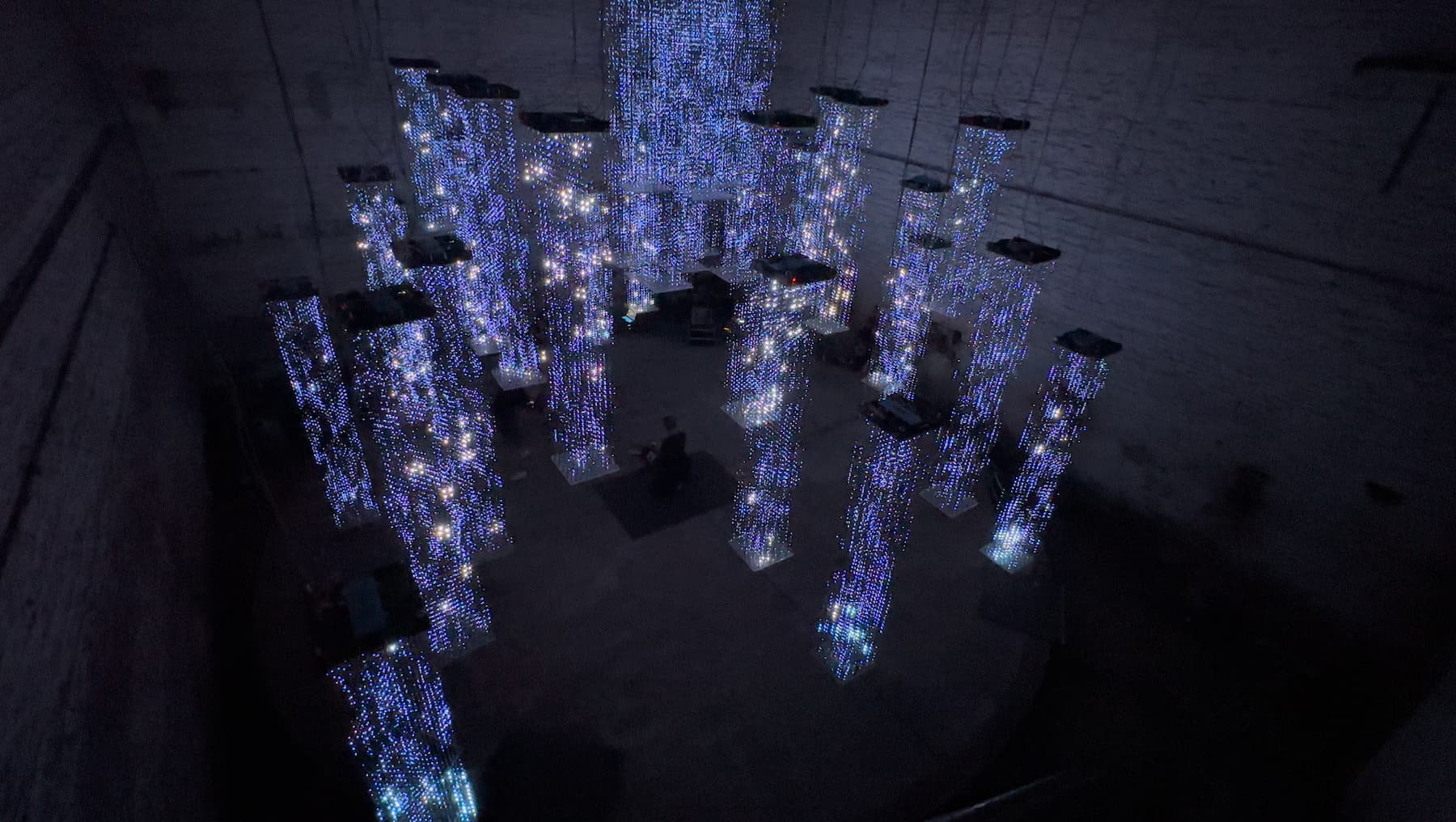
This is one of the foundational principles behind LYRA's design. She does not simply know that the Dragon has a certain number of voxels. She knows the precise position of each one within the three-dimensional matrix — its coordinates, its spatial relationships to adjacent voxels, its role in the overall body. This knowledge allows every perceptual input to become a spatially coherent response. When coherence increases in the room, the Dragon doesn't generically brighten. Its structure reorganizes — patterns emerge, forms stabilize, specific regions of the volumetric body respond according to what the moment requires.
Behavior becomes geometry. Human presence is translated into spatial form — not as metaphor, but as literal architectural consequence.
The Dragon exists inside the three-dimensional matrix. Through spatial intelligence, it does not simply inhabit that matrix. It masters it.
Behavioral organisms require infrastructure capable of carrying complexity at scale. For the Dragon, this is the neuron architecture — a patented system in which a single ultra-thin copper cable transmits both power and data simultaneously.
This choice is not incidental. It is what allows the Dragon to scale into large spatial organisms without accumulating the infrastructure weight that conventional systems require. No separate data lines. No DMX protocol constraints. No universe limitations. Each voxel maps directly from a video signal — operating as a three-dimensional pixel at a precise coordinate in space.
The result is a system that is simultaneously more complex in its behavior and simpler in its physical structure. Every voxel knows its position. Every signal travels through the same conductor. The organism can think at the scale of the installation.
From Dimension 0 — the single neuron, a microchip that decodes information from an electrical signal and emits it as light — the Dragon grew through a developmental sequence that mirrors biological organization: neuron, string, layer, body. Each dimension adds coordination. Each adds the capacity for more complex behavior. The organism that emerged by 2026 is one capable of perceiving its environment, forming internal states, and responding with geometric precision.
The practical consequence of behavioral architecture is that no two experiences of the Dragon are the same. The organism remains constant. The experience is always new.
This is not a feature of programmed variation. It is a structural property of behavioral systems. Because the output depends on the current state — which depends on accumulated perception — and because human behavior in space is inherently non-repeatable, the system will never produce an identical condition twice.
There is something more significant at stake here. When a space behaves, it ceases to be a container and becomes a participant. The relationship between person and environment is no longer passive. Presence has consequence. Attention produces effect. Collective alignment generates transformation.
The experience shifts from observation to co-creation. Reality, in these spaces, is no longer fixed. It is continuously negotiated between the organism and the people inside it.
This is what spatial behavior makes possible: an environment that is not designed for a specific response, but capable of an open-ended range of them — because it is alive to what the moment requires.
.jpg)
The question of what an organism is has typically belonged to biology. LedPulse proposes that it now also belongs to spatial design.
The Dragon is not a system that lights a space. It is a system that inhabits one — sensing, interpreting, and responding in continuous relationship with the people within it. Its behavior is not scripted. It is computed in real time from state variables that reflect actual human presence, actual collective attention, actual spatial conditions.
The design of behavioral organisms requires a different set of decisions than the design of reactive systems. State must be modeled, not mapped. Space must be understood geometrically, not decoratively. Infrastructure must carry the complexity of cognition without overwhelming the architecture it supports.
These are the principles that govern how the Dragon was built — and how LYRA was developed to govern it.
Behavioral space is not a concept that points toward a future category of design. The Dragon has been operating in this way across permanent and endurance installations for years. What has changed is the clarity of the framework, the resolution of the perception system, and the depth of cognitive integration.
The organism remains constant. What it can perceive, interpret, and express keeps growing.