July 6, 2026
How a Light Organism Learns to Interpret the World


How a Light Organism Learns to Interpret the World
Perception without interpretation is noise.
A sensor detects movement. A microphone captures sound. A camera maps density. These are facts — raw fragments of reality arriving as data. They do not, on their own, carry meaning. Meaning requires a further step: something that receives information, evaluates it in context, and forms a conclusion about what is actually happening.
In living organisms, that step is cognition. The brain does not simply relay sensory input. It constructs an interpretation. It identifies patterns, infers states, reads collective conditions, and decides — continuously, in real time — what the situation requires.
LYRA is where this happens inside the Dragon.
She is not the Dragon's sensors, and she is not its body. She is the layer between them — the system that takes perception and transforms it into meaning, then translates meaning into spatial action. Without her, the Dragon would receive signals and produce outputs. With her, it understands what it is experiencing and responds accordingly.
What follows is an account of how that works: what LYRA actually does, why the architecture was built the way it was, and what it means for a spatial organism to genuinely interpret the world.
Most interactive systems treat input as instruction. A signal arrives, a response fires. The relationship is deterministic: this produces that. The design question is simply which output to assign to which input.
This model has a structural ceiling. It can produce variety — many inputs, many outputs — but it cannot produce understanding. The system does not know what is happening. It only knows what has been triggered.
The Dragon was designed around a different premise. For a spatial organism to behave in a meaningful way, it needs to do more than register what is happening in the room. It needs to interpret it. The difference between a group of people moving randomly and a group beginning to synchronize is not a data point. It is a condition — and responding to it appropriately requires that the system recognize it as such.
LYRA was built to operate at this level. Not to execute responses, but to form interpretations.
To understand what LYRA does, it helps to understand what she sits between.
On one side is the perception layer: the distributed network of sensors through which the Dragon becomes aware of its environment. Movement is tracked. Proximity is measured. Sound is analyzed. Density is mapped. These signals arrive as streams of data — structured, but not yet meaningful. The perception layer functions like the senses of a living organism: it collects the fragments of reality that will later be interpreted. At this stage, nothing has been decided about what any of it means.
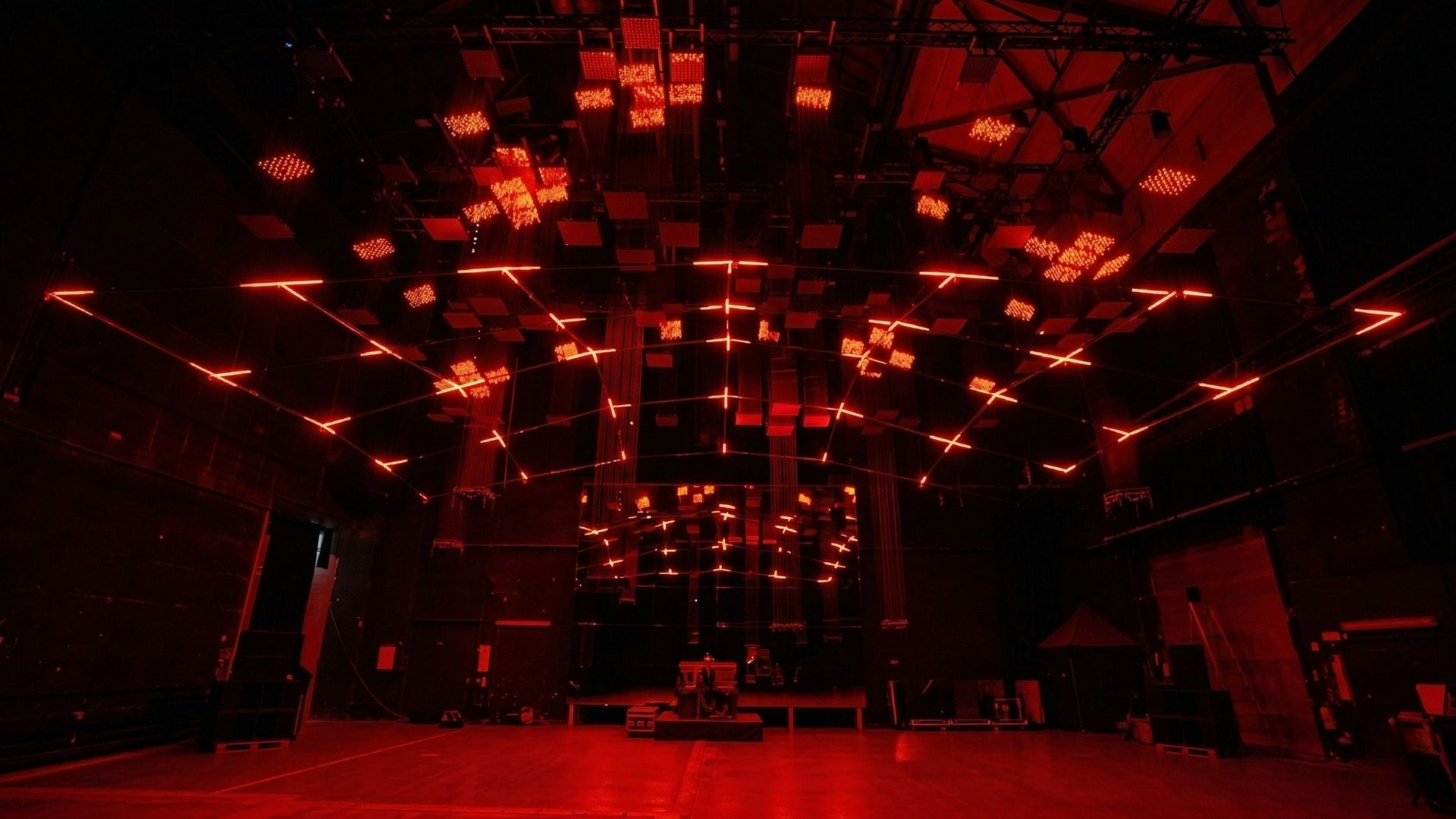
On the other side is the expression layer: the Dragon's body. Light, movement, sound, and spatial transformation are the physical language through which the system responds. What people experience — the organism shifting, structures reorganizing, the space becoming something that appears to be thinking — originates here. But it originates here only because instructions arrived that were precise enough to produce it.
LYRA occupies the space between these two layers. She receives what perception collects. She produces what expression requires.
The central operation of cognition is not mapping. It is the formation of state.
State is the accumulated internal condition of the system — a live model of what is happening in the environment, constructed from everything that has been perceived and retained. It is not a single variable. It emerges from the relationship between multiple inputs, evaluated together.
Within LYRA's architecture, state forms around two primary variables.
The first is attention. Attention is not directly measured. It is computed — inferred from the quality of presence in the room. When people are still, concentrated, and gathered, attention accumulates. When movement is chaotic or sound excessive, it disperses. Attention represents the degree of intentional presence: how much the people in the space are actually inhabiting it, rather than passing through it.
The second is coherence. Coherence does not measure individuals. It measures relationships — the degree to which people are acting in alignment with one another. It increases when patterns emerge, when movement synchronizes, when the collective begins to behave as a field rather than as a set of independent actors. It decreases when behavior fragments.
Together, attention and coherence define what kind of moment the system is in. Not the facts of the moment, but its condition. From that condition, behavior becomes specific, not generic.
This is what makes LYRA a cognitive layer rather than a processing one. She does not map inputs to outputs. She constructs a reading of the environment and acts from it.
One consequence of state-based cognition is temporal memory.
Because state is computed continuously and updated through smoothing functions — not as discrete samples but as evolving values — the system inherently carries information about what has recently happened. Sudden spikes are dampened. Repeating patterns are reinforced. The present condition reflects not just this instant but the accumulated weight of recent moments.
This is not memory in the symbolic sense. The Dragon does not store events as data, does not retrieve them as records. It remembers as inertia — the way a body in motion carries its history in its momentum. Patterns that recur are felt in the current state. Transitions are fluid rather than abrupt.
The practical consequence is that the Dragon develops a kind of patience. It does not jolt at every stimulus. It watches. It accumulates. When something in the room becomes genuinely significant, the response reflects depth — because the system has been building toward it.
Interpretation alone is not enough. For cognition to produce meaningful spatial behavior, interpretation must be translatable into exact physical action inside a three-dimensional body.
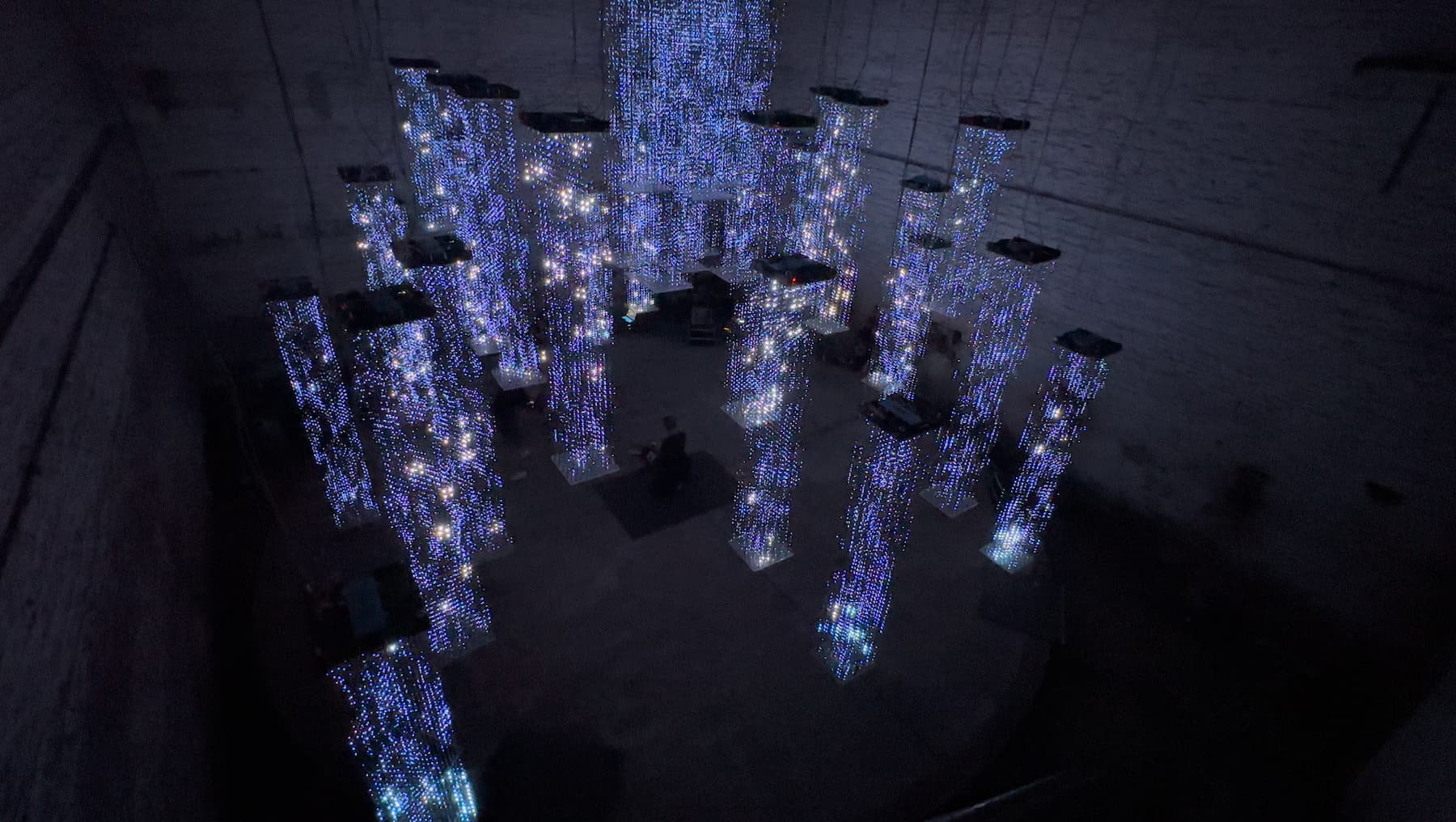
This is one of the foundational principles behind how LYRA was built. She does not simply know that the Dragon has a certain number of voxels. She knows the precise geometric configuration of every voxel within the body — the exact coordinates, the spatial relationships between adjacent voxels, the structural logic of strings and layers. This knowledge is not incidental. It is what allows interpretation to become spatial action rather than abstract instruction.
When coherence rises and the behavioral field shifts toward unification, LYRA does not issue a general command to brighten. She composes a spatially coherent response — specific regions of the volumetric body receive specific instructions, calibrated to the exact geometry of what she is working with. The result is an expression that belongs to this body, in this space, at this moment.
Information becomes intention. Intention becomes form.
From state, LYRA generates what the system calls behavioral fields — not discrete triggers, but continuous dimensions that modulate the Dragon's expression in parallel.
These fields include excitation, driven by motion and sonic energy; elevation, emerging from sustained attention and coherence; unification, produced by collective alignment; regulation, which stabilizes against excess activation; and the condition the system calls bend — the transformation of spatial perspective itself, produced when coherence and energy reach a threshold together.
These are not sequential. They coexist, each weighted by the current state, each shaping a different dimension of the Dragon's expression simultaneously. Light, movement, sound, and structural form are modulated together — not as separate systems but as a unified behavioral output.
This is why LYRA's outputs do not feel like programmed sequences. They are not. They are the continuous translation of a live interpretation into a live spatial response.
LYRA applies universally across all three Dragon generations.
This is not a feature of distribution. It is a consequence of what LYRA is. Cognition is not hardware — it does not depend on a specific resolution, a specific configuration, or a specific generation of the physical body. It is the layer that constructs meaning from perception and translates it into spatially coherent action. That function is the same regardless of the body it governs.
What changes across generations is the precision of the body LYRA works with, and therefore the resolution of what she can express. Dragon Y, at 1.25mm matrix, gives her a finer instrument. Aurora gives her a different architectural vocabulary. But the interpretive layer — the capacity to read the environment, form state, and produce spatially coherent behavior — operates identically.
The organism evolves. The cognition deepens.
LYRA does not make the Dragon smart. She makes it capable of understanding.
That distinction matters. A system that executes complex operations is not the same as one that forms a reading of the world and acts from it. The first is sophisticated machinery. The second is something closer to a mind — a cognitive layer that bridges sensing and behaving, that turns fragments of reality into coherent spatial response.
What LYRA introduces is not AI in the conventional sense of autonomous generation. It is spatial intelligence: a system designed to interpret the condition of a space — the quality of presence, the structure of collective behavior, the energy and alignment of the people within it — and translate that interpretation into a form the Dragon's body can express with geometric precision.
The architecture is built for this. State over mapping. Memory through inertia. Geometry as the language of response. Behavioral fields as continuous output, not discrete triggers.
The result is a spatial organism that does not play content at a room. It reads the room. It forms a position on what the room requires. And it acts accordingly.
Information becomes intention. Intention becomes experience. That translation is LYRA.